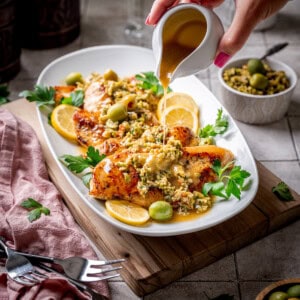
Martini Chicken with Homemade Green Olive Tapenade
This recipe for Martini Chicken turns cocktail hour into dinner. Juniper, vermouth, and briny olives transform basic chicken into a fancy meal without the fuss!
Equipment
- Meat mallet (optional but recommended): For pounding the chicken to even thickness. A heavy skillet will work here if you don't own a meat mallet.
- Spice grinder (optional but recommended) A mortar and pestle works well here too. If you don't have a spice grinder, you can buy pre-ground juniper, but the flavor won't be as bright.
- Food processor (optional but recommended) If you don't have a food processor, you can chop everything by hand and combine in a bowl.
- small saucepan for the sauce
- Fine mesh strainer for removing solids from the sauce base
- large skillet to cook the chicken
- whisk for the sauce
- meat thermometer (optional but recommended) to check the internal temp of the chicken
Ingredients
For the Tapenade
- 1 ½ cups green olives rinsed, pitted and halved or sliced
- 2 teaspoons capers rinsed
- ¼ cup parsley leaves
- ¼ cup extra virgin olive oil
- Zest of 1 lemon
- 3 Tablespoons lemon juice
- 1 large garlic clove minced
- 4 large basil leaves torn
For the Sauce
- ½ cup dry white vermouth
- ¼ cup chicken stock low-sodium or unsalted
- 10 juniper berries cracked gently with the side of a knife
- 10 black peppercorns whole
- 1 small shallot small dice
For the Chicken
- 4 Tablespoons unsalted butter cold
- 2 chicken breasts cut lengthwise into 4 pieces and pounded to uniform thickness (about ½” each)
- 10 juniper berries freshly ground
- 2 teaspoons Kosher salt
- 1 teaspoon black pepper
- 3 Tablespoons olive oil

Instructions
Make the Tapenade First
- Put the olives and capers in a strainer and rinse them under cold water for about 10 seconds. This washes off excess brine so the tapenade doesn't taste so salty. Transfer them into a food processor.1 ½ cups green olives, 2 teaspoons capers
- Add the parsley, olive oil, lemon zest, lemon juice, garlic, and torn basil to the food processor with the olives and capers. Pulse 5 to 10 times until you have a chunky, relish-like texture (alternatively, hand chop with a knife). You're not making a smooth paste. You want visible pieces of olive and flecks of herb. Scrape it into a bowl and set it aside. The tapenade can sit at room temperature for an hour or in the fridge for up to three days.¼ cup parsley leaves, ¼ cup extra virgin olive oil, Zest of 1 lemon, 3 Tablespoons lemon juice, 1 large garlic clove, 4 large basil leaves
Start the Sauce
- In a small saucepan, combine the vermouth, chicken stock, cracked juniper berries, peppercorns, and diced shallot. Bring it to a simmer over medium heat and let it reduce by half. This takes about 8 to 10 minutes.½ cup dry white vermouth, ¼ cup chicken stock, 10 juniper berries, 10 black peppercorns, 1 small shallot
- Once it's reduced, pour it through a fine mesh strainer into a measuring cup, pressing on the solids to extract all the flavor. Discard the solids.
- Pour the strained liquid back into the pan and continue reducing over medium-low heat. You're aiming for about ¼ cup of liquid. If it starts to reduce too much before the chicken is done, just turn off the heat. You can reheat it gently later.
Prep and Season the Chicken
- Cut your chicken breasts lengthwise to get 4 thin chicken cutlets. If your chicken breast cutlets are thicker than ½ inch, place them between two sheets of plastic wrap and pound them with a meat mallet or heavy skillet until they're uniform.2 chicken breasts
- Grind the juniper berries in a spice grinder until they're like pepper, then mix them with the salt and black pepper in a small bowl.10 juniper berries, 2 teaspoons Kosher salt, 1 teaspoon black pepper
- Pat the chicken breasts dry with paper towels. This step matters because wet chicken won't brown as well. Sprinkle the spice mixture all over both sides of the chicken, pressing it in gently so it sticks.
Cook the Chicken
- Heat a large skillet over medium heat. Once it's hot, add the olive oil and swirl it around to coat the bottom. Lay the chicken breasts in the pan gently, being careful not to splash hot oil. Press down on each breast with a spatula for about 10 seconds. This ensures full contact with the pan for better browning.3 Tablespoons olive oil
- Let the chicken cook undisturbed for 3 minutes. You'll see the edges start to turn opaque and golden. Flip the chicken and cook for another 3 minutes on the second side. The chicken should have a golden crust and feel firm when you press it. The chicken should be ready to remove at this point (check that the internal temp is around 155°-160°F).
- Remove the chicken to a plate, tent it loosely with foil, and let it rest while you finish the sauce.
Finish the Sauce, Plate and Serve
- Check your saucepan. You should have about ¼ cup of liquid left. If you have more, reduce it a bit more over medium heat. Once you're there, pull the pan off the heat and let it cool for one minute. This step is crucial because if the liquid is too hot, the butter will separate instead of emulsifying.
- Add one tablespoon of cold butter and whisk it in until it's fully melted and incorporated. Repeat with the remaining three tablespoons, one at a time. The sauce should turn glossy and thicken slightly. Taste it and add a pinch of salt if needed.4 Tablespoons unsalted butter
- Place the cooked chicken breasts on plates, spoon the sauce over each one then top with a generous scoop of tapenade. If you want (we always do) add some more sauce right over the top of the tapenade as well. Serve immediately.
Notes
Substituions:
- Chicken Breasts: Chicken tenders or chicken thighs, thin pork chops or turkey cutlets work just as well as chicken although cook time may vary depending on the type of protein used.
- Green Olives: Use different olives, such as Kalamata olives, to change the flavor of your tapenade.
- Lemon: Lime works here as well.
- Vermouth: A dry white wine can be used in place of vermouth for a slightly different flavor profile.
- Chicken Stock: Vegetable stock is a good option if you don't have chicken stock.
- Shallot: A small yellow onion will work in the sauce in place of shallots.
- How to store leftover Martini Chicken: The cooked chicken can go in an airtight container in the fridge for up to three days. The sauce will solidify as it cools because of the butter, which is normal. Store it separately in a small container. The tapenade keeps the longest, up to a week in the fridge in a jar with a thin layer of olive oil on top to prevent oxidation.
- How to reheat leftover Martini Chicken: To reheat, slice the chicken and warm it gently in a skillet over low heat with a splash of chicken stock or water to keep it moist. Reheat the sauce separately in a small pan over low heat, whisking in a tiny pat of butter to bring back the glossy texture. Don't microwave the chicken or it'll turn rubbery. The tapenade can be served cold or at room temperature, so just pull it from the fridge 15 minutes before you eat.
- Can you freeze leftover Martini Chicken? The chicken is the only component of this dish that can be frozen. If you freeze the chicken, do it without the sauce. Wrap it tightly in plastic wrap and then foil, and it'll keep for up to two months. Thaw it overnight in the fridge and reheat as directed. The sauce doesn't freeze well because the emulsion breaks when it thaws. The tapenade also won’t freeze well as you’ll lose flavor and texture.
- Let the chicken come to room temperature before cooking. Cold chicken hits a hot pan and the exterior overcooks before the center is done. Pull it from the fridge 15 minutes before you season it.
- Don't crowd the pan. If your skillet isn't big enough for all 4 pieces of chicken, cook them two at a time. Crowding drops the pan temperature and the chicken steams instead of searing. You lose the crust and the fond, which means your sauce will be weaker.
- Taste the sauce for salt. Vermouth varies in saltiness and your chicken stock might have been seasoned differently. A tiny pinch of salt can make the difference between a sauce that tastes flat and one that amazes.
Nutrition
Calories: 441kcalCarbohydrates: 6gProtein: 20gFat: 35gSaturated Fat: 11gPolyunsaturated Fat: 3gMonounsaturated Fat: 19gTrans Fat: 0.5gCholesterol: 85mgSodium: 2105mgPotassium: 424mgFiber: 2gSugar: 2gVitamin A: 919IUVitamin C: 12mgCalcium: 50mgIron: 1mg
Tried this recipe?Let us know how it was!
