
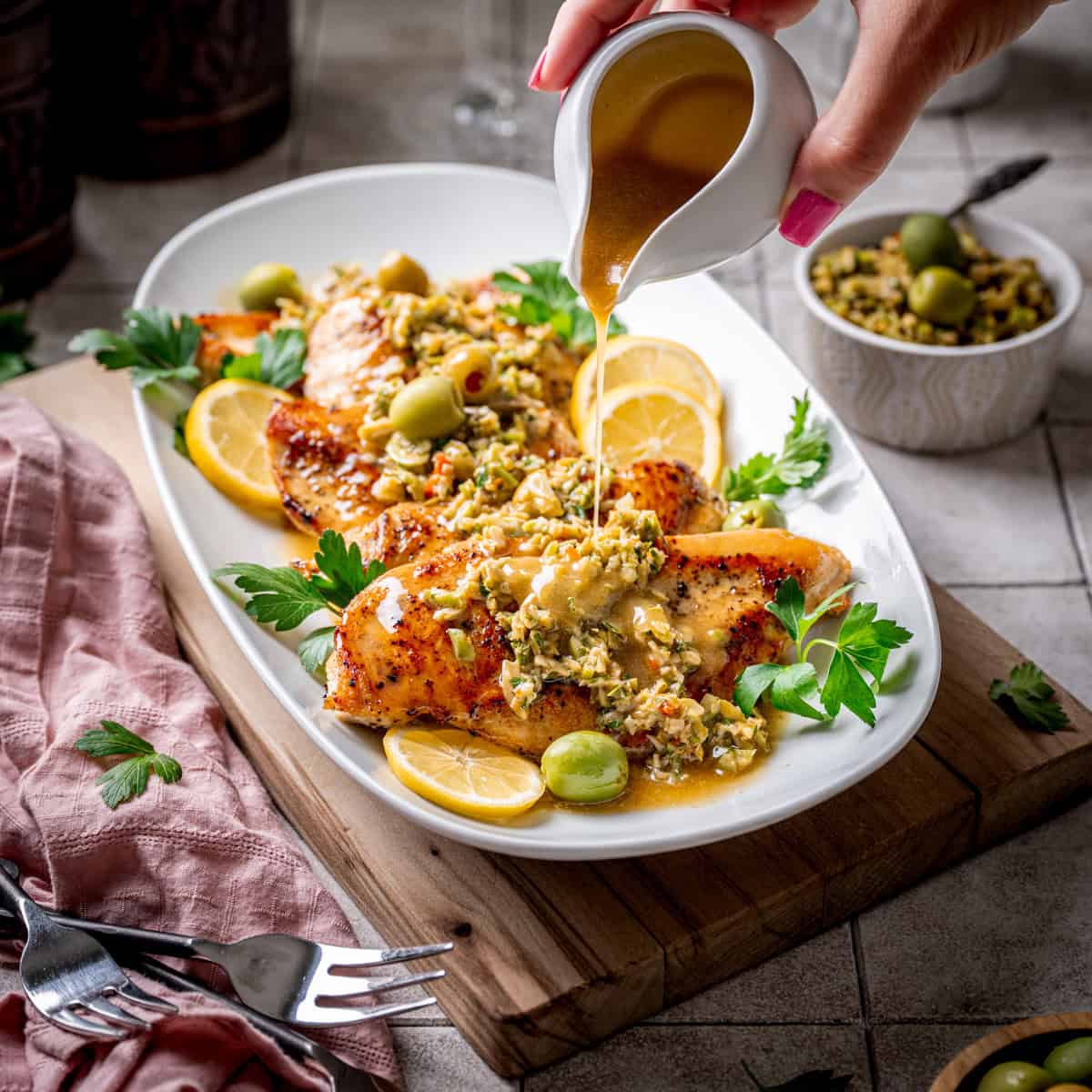
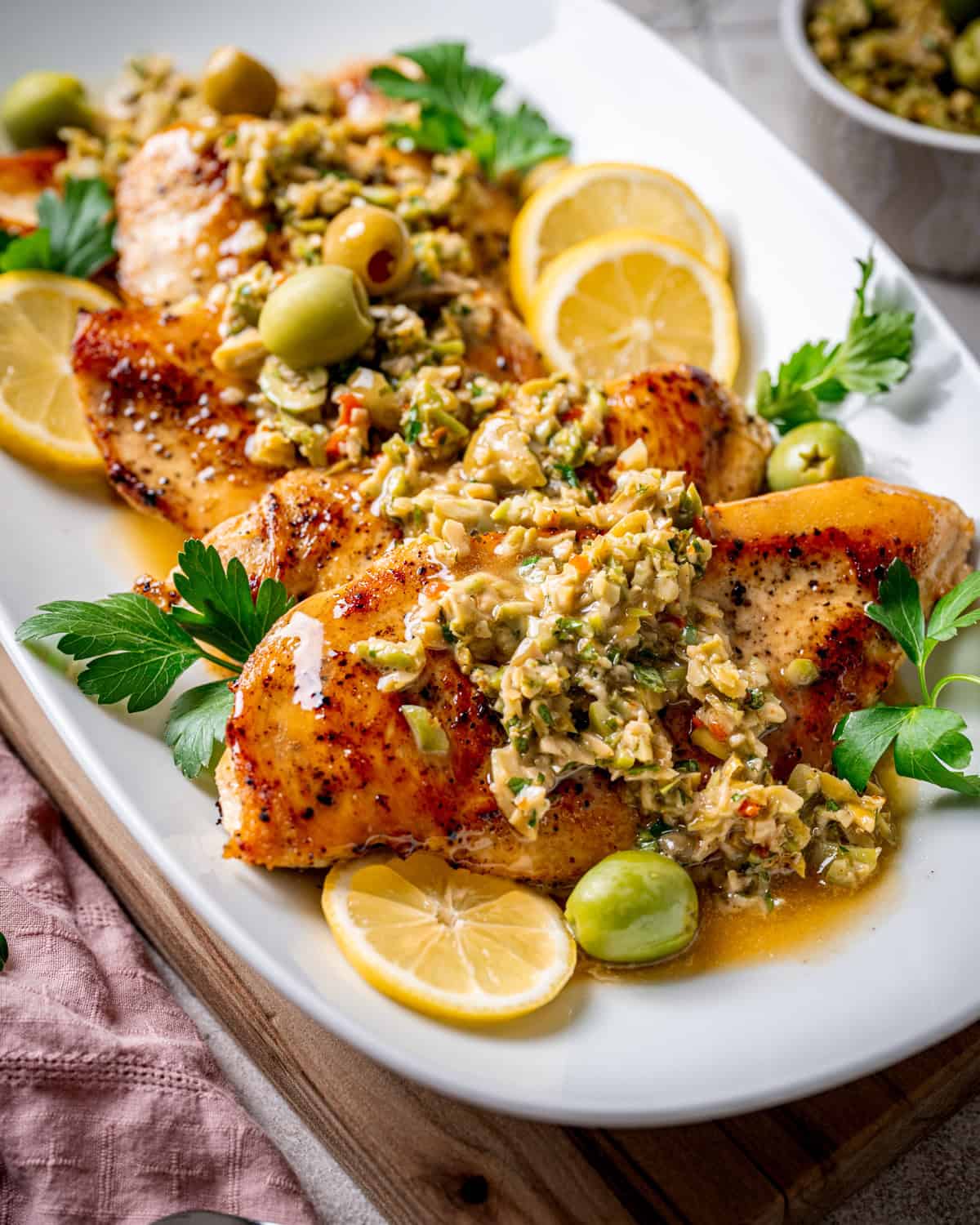
How about an easy chicken dish that actually has so much flavor you'll be shocked? You've got juniper berries in the crust of the chicken giving you the first step in your martini building meal! But using dry white vermouth in a glossy butter sauce, and a delightful green olive tapenade round out this Martini Chicken recipe. It's the kind of dish that seems and looks way more complicated than it is. Purposeful flavor layering and a bit of whimsical cooking, and you have yourself a winning dish that you will make over and over.
This is fancy food that doesn't require fancy skills so enjoy!
Looking for more dishes like this? Try out our Olive and Artichoke Braised Chicken or Cheesy Pistachio Pesto Chicken with Roasted Cherry Tomatoes.
Jump to:
- Why You'll Love this Recipe
- What is Martini Chicken?
- How to Make Martini Chicken
- Ingredients
- Equipment
- Step-by-Step Instructions
- Variations
- Storage
- Leftover Transformations
- Top Tips from the Pros
- Troubleshooting
- What to serve with Martini Chicken
- What Drinks to Pair with Martini Chicken
- FAQ
- Related
- Pairing
- 📖 Recipe
Why You'll Love this Recipe
- It's fairly easy to make
- If you have extra, the tapenade can be used on virtually anything!
- A great way to make the humble chicken breast the star of the show!
- The sauce is a show stopper and can be used elsewhere also.
- It's fun! Who wouldn't want martini chicken for dinner??
What is Martini Chicken?
Martini chicken is a modern riff that pulls from the flavor profile of a classic gin martini and converts it into a tasty chicken dish. The techniques are mostly French, especially the sauce that brings vermouth and butter together to make a lovely, restaurant-style sauce, and blends it with Mediterranean ingredients like olives, capers, and fresh herbs.
The juniper berry component is the nod to the gin used in a classic martini (not focusing on vodka martinis here). This helps give the chicken a bit of the flavor you'd get from the botanicals in a classic London dry gin. giving the chicken that piney, floral backbone you'd recognize in a good martini. Vermouth is a great alternative to wine when making a sauce and it is perfect here, since we want that flavor associated with a martini. Add some briny olives and you've got a dirty martini on a plate!
Although it's a playful dish, it is ingredient-driven cooking that has a deep, bold and delicious flavor.

Why This Recipe Actually Works
Pounding the chicken to a half-inch thickness means it cooks evenly in about six minutes. You won't have the issues of underdone, raw thick parts of the chicken or the rubbery, dry overcooked version. You'll get a nice golden crust and juicy meat. Ground juniper berries are in the seasoning blend on the chicken and as well as in the sauce, so every bite has a subtle botanical punch reminiscent of gin.
The vermouth reduces twice, first with aromatics to concentrate the flavor, then a second time after straining so you're left with a smooth but nicely flavored sauce base. This double reduction is what makes the sauce taste restaurant-level instead of flat and one-dimensional.
When you whisk cold butter into that reduced liquid off the heat, you're creating an emulsion that turns thin liquid into a silky, glossy sauce that clings to the chicken. If you add the butter while it's still extremely hot or boiling, it will break into a mess and look and taste greasy.
The olives and capers in the tapenade get rinsed before processing, which deadens some of the aggressive salty brine. This helps bring out the flavors in the olives more. You want a chunky topping, not a paste, so you pulse instead of purée the tapenade ingredients. That texture contrast against the smooth sauce and tender chicken is exactly what you want. Every component has a distinct place and the whole dish comes together brilliantly.
How to Make Martini Chicken
Complex in flavor but not as much in preparation. The tapenade can be made in advance, but is quite simple in a food processor. The sauce and chicken are easily prepared together. The sauce will take a bit longer to bring to a finish but it's pretty easy to make overall.
Ingredients
Tapenade Ingredients:
- Green olives: The base of the tapenade and the briniest, most assertive element on the plate. We use a combo of Castelvetrano olives and martini olives, but any meaty green olive you can find will work. If your olives come with pits, you'll need extra time to remove them.
- Capers: They add sharpness and floral brine that's different from the olive brine. Rinse them just like the olives or they'll tend to be unappealingly assertive.
- Parsley: Brings freshness and color. It brightens the heavy, salty olive flavor and keeps the tapenade from feeling one-dimensional. Use the fresh Italian parsley variety as it is preferred for its flavor.
- Extra-virgin olive oil: The binder that turns chopped ingredients into a cohesive relish. It also adds richness and a fruity backbone. Use something decent, not the dusty bottle from 2019.
- Lemon zest and juice: Acidity from fresh lemon juice cuts through the richness of the olives and the butter sauce. Zest adds aromatic oils that juice alone can't deliver. If you skip the zest, the tapenade tastes duller.
- Garlic: Sharpness and bite. One garlic clove is enough because raw garlic is strong and you don't want it to dominate the olives. Mince it fine before adding it to your olive mix or the food processor won't break it down evenly.
- Fresh basil: A pop of sweetness and fragrance that makes the tapenade feel summery and alive. Don't substitute dried. Tear it by hand so it doesn't bruise and turn bitter.
Chicken Ingredients:
- Chicken breasts: Pounding them ensures even cooking. If you leave them thick, the outside will be overcooked by the time the center is done. The chicken takes on the juniper, salt, and pepper very nicely.
- Juniper berries: The botanical part of a martini. They're piney and slightly citrusy, with a nice floral component. We recommend buying whole juniper berries then grind them fresh in a spice grinder or using a mortal and pestle for best results.
- Kosher salt: Seasoning and moisture retention. Kosher salt has larger crystals and distributes more evenly than table salt. If you use table salt, cut the amount in half or the chicken will be over-seasoned.
- Black pepper: Adds a touch of heat and aromatics.
- Olive oil: For searing. You need enough to coat the pan and create that golden crust. No need to use a super high quality EVOO here since you are cooking with it instead of drizzling.
Sauce Ingredients:
- Dry white vermouth: This is a major component here. Dry vermouth is fortified wine with botanicals, so it brings acidity, sweetness, and herbal complexity all at once. Dry, white vermouth (not sweet) is what you want.
- Low-sodium chicken stock: Adds body and savory depth and we suggest low-sodium or the final sauce might be too salty.
- Juniper berries: Cracking them releases the oils a bit more in the stock and vermouth. You can easily do this with the side of a knife.
- Whole black peppercorns: Whole peppercorns infuse the sauce with heat without making it gritty. You'll strain them out so they add subtle flavor without texture.
- Shallot: Shallots are our go-to for the delicate flavor. It's almost like using part sweet onion, 2 parts normal onion and a hint of garlic with a bit of unexplained flavor as well.
- Unsalted butter: The final touch that turns thin liquid into luxurious sauce. Cold butter is key because it emulsifies into the liquid instead of melting into a greasy layer. Unsalted butter lets you control the seasoning.
See recipe card below for quantities.
Equipment
- Meat mallet (optional but recommended: For pounding the chicken to even thickness. A heavy skillet will work here if you don't own a meat mallet.
- Spice grinder (optional but recommended): Juniper berries are too hard to crush by hand. A coffee grinder works perfectly, and even better is to have one dedicated just to spices. A mortar and pestle works well here too. If you don't have a spice grinder, you can buy pre-ground juniper, but the flavor won't be as bright.
- Food processor (optional but recommended): The tapenade needs to be chunky, not smooth, so pulsing in a processor gives you control. If you don't have a food processor, you can chop everything by hand and combine in a bowl.
- Small saucepan: For reducing the vermouth sauce. We find that a shallow wider pan works a bit better since there is more surface area compared to a deeper pot.
- Fine mesh strainer: For removing solids from the sauce base
- Large skillet: Big enough to fit your chicken breasts without over-crowding.
- Whisk: For mounting the butter into the sauce.
- Meat thermometer: We always recommend an instant-read thermometer to ensure that your chicken is cooked properly.
Step-by-Step Instructions
Make the Tapenade First
- Put the olives and capers in a strainer and rinse them under cold water for about 10 seconds. This washes off excess brine so the tapenade doesn't taste so salty. Transfer them into a food processor.
- Add the parsley, olive oil, lemon zest, lemon juice, garlic, and torn basil to the food processor with the olives and capers. Pulse 5 to 10 times until you have a chunky, relish-like texture (alternatively, hand chop with a knife). You're not making a smooth paste. You want visible pieces of olive and flecks of herb. Scrape it into a bowl and set it aside. The tapenade can sit at room temperature for an hour or in the fridge for up to three days.
Start the Sauce
- In a small saucepan, combine the vermouth, chicken stock, cracked juniper berries, peppercorns, and diced shallot. Bring it to a simmer over medium heat and let it reduce by half. This takes about 8 to 10 minutes.
- Once it's reduced, pour it through a fine mesh strainer into a measuring cup, pressing on the solids to extract all the flavor. Discard the solids.
- Pour the strained liquid back into the pan and continue reducing over medium-low heat. You're aiming for about ¼ cup of liquid. If it starts to reduce too much before the chicken is done, just turn off the heat. You can reheat it gently later.
Prep and Season the Chicken
- Cut your chicken breasts lengthwise to get 4 pieces. If your chicken breast pieces are thicker than ½ inch, place them between two sheets of plastic wrap and pound them with a meat mallet or heavy skillet until they're uniform. Grind the juniper berries in a spice grinder until they're like pepper, then mix them with the salt and black pepper in a small bowl.
- Pat the chicken breasts dry with paper towels. This step matters because wet chicken won't brown as well. Sprinkle the spice mixture all over both sides of the chicken, pressing it in gently so it sticks.
Cook the Chicken
- Heat a large skillet over medium heat. Once it's hot, add the olive oil and swirl it around to coat the bottom. Lay the chicken breasts in the pan gently, being careful not to splash hot oil. Press down on each breast with a spatula for about 10 seconds. This ensures full contact with the pan for better browning.
- Let the chicken cook undisturbed for 3 minutes. You'll see the edges start to turn opaque and golden. Flip the chicken and cook for another 3 minutes on the second side. The chicken should have a golden crust and feel firm when you press it. The chicken should be ready to remove at this point (check that the internal temp is around 155°-160°F).
- Remove the chicken to a plate, tent it loosely with foil, and let it rest while you finish the sauce.
Finish the Sauce, Plate and Serve
- Check your saucepan. You should have about ¼ cup of liquid left. If you have more, reduce it a bit more over medium heat. Once you're there, pull the pan off the heat and let it cool for one minute. This step is crucial because if the liquid is too hot, the butter will separate instead of emulsifying.
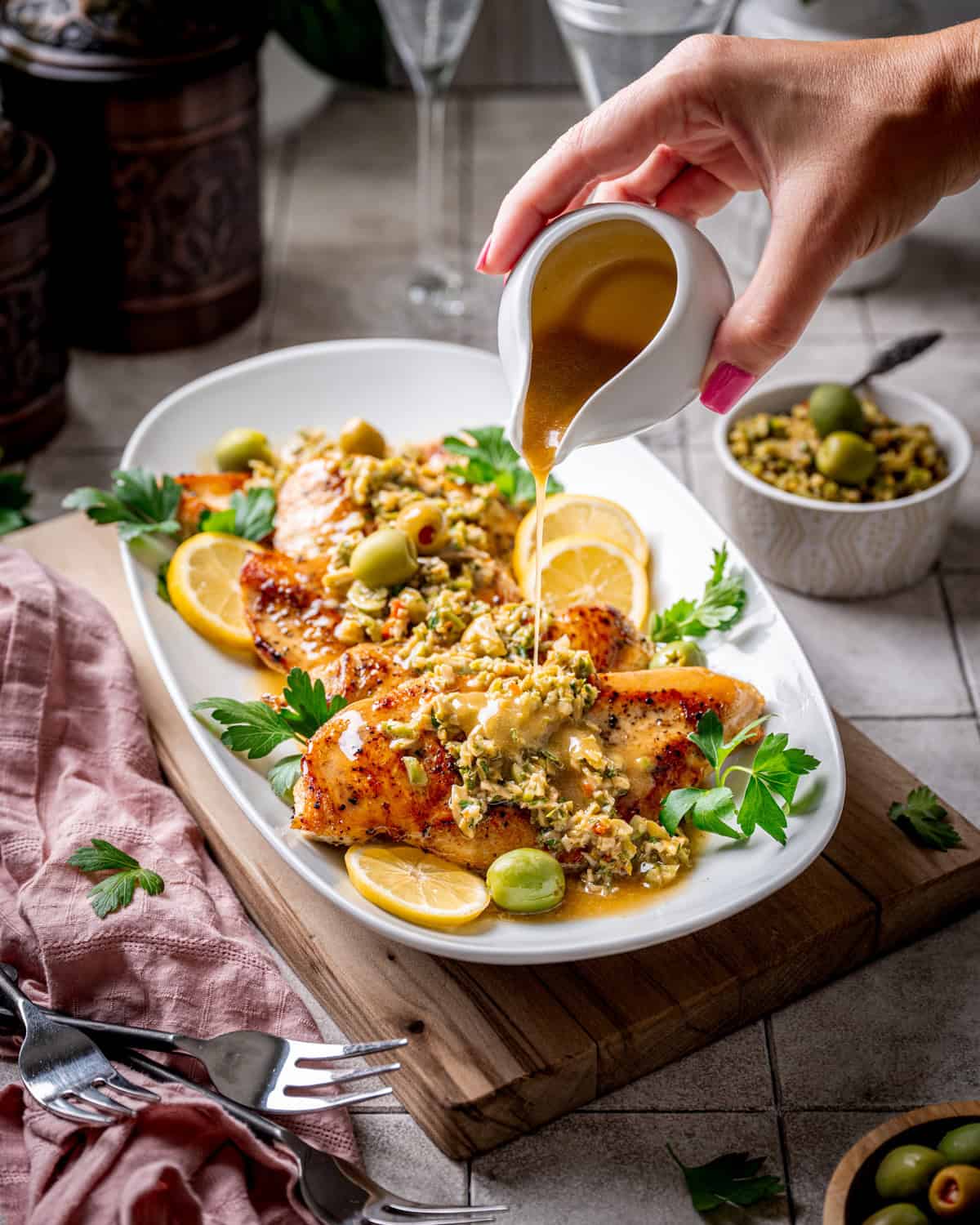
- Add one tablespoon of cold butter and whisk it in until it's fully melted and incorporated. Repeat with the remaining three tablespoons, one at a time. The sauce should turn glossy and thicken slightly. Taste it and add a pinch of salt if needed.
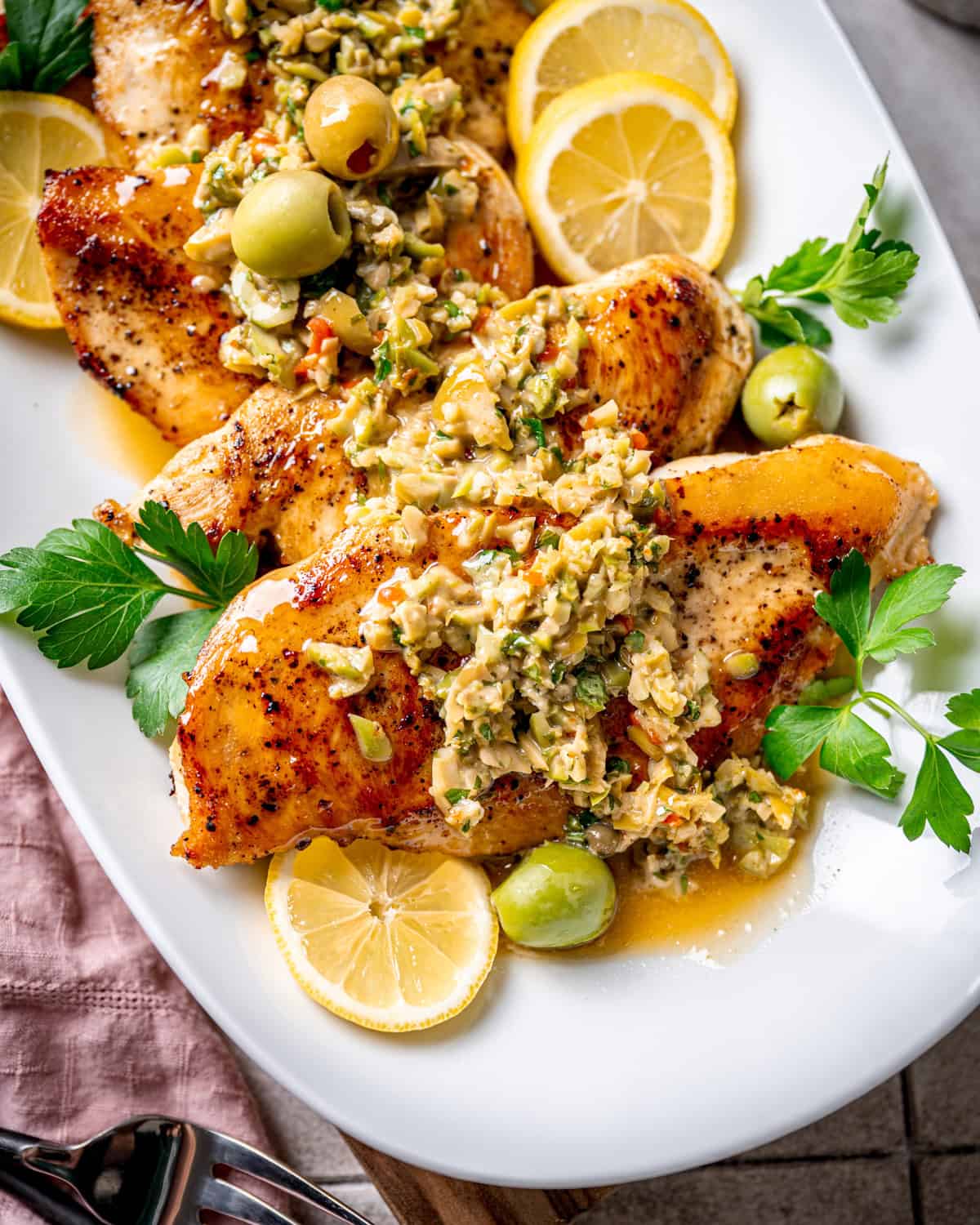
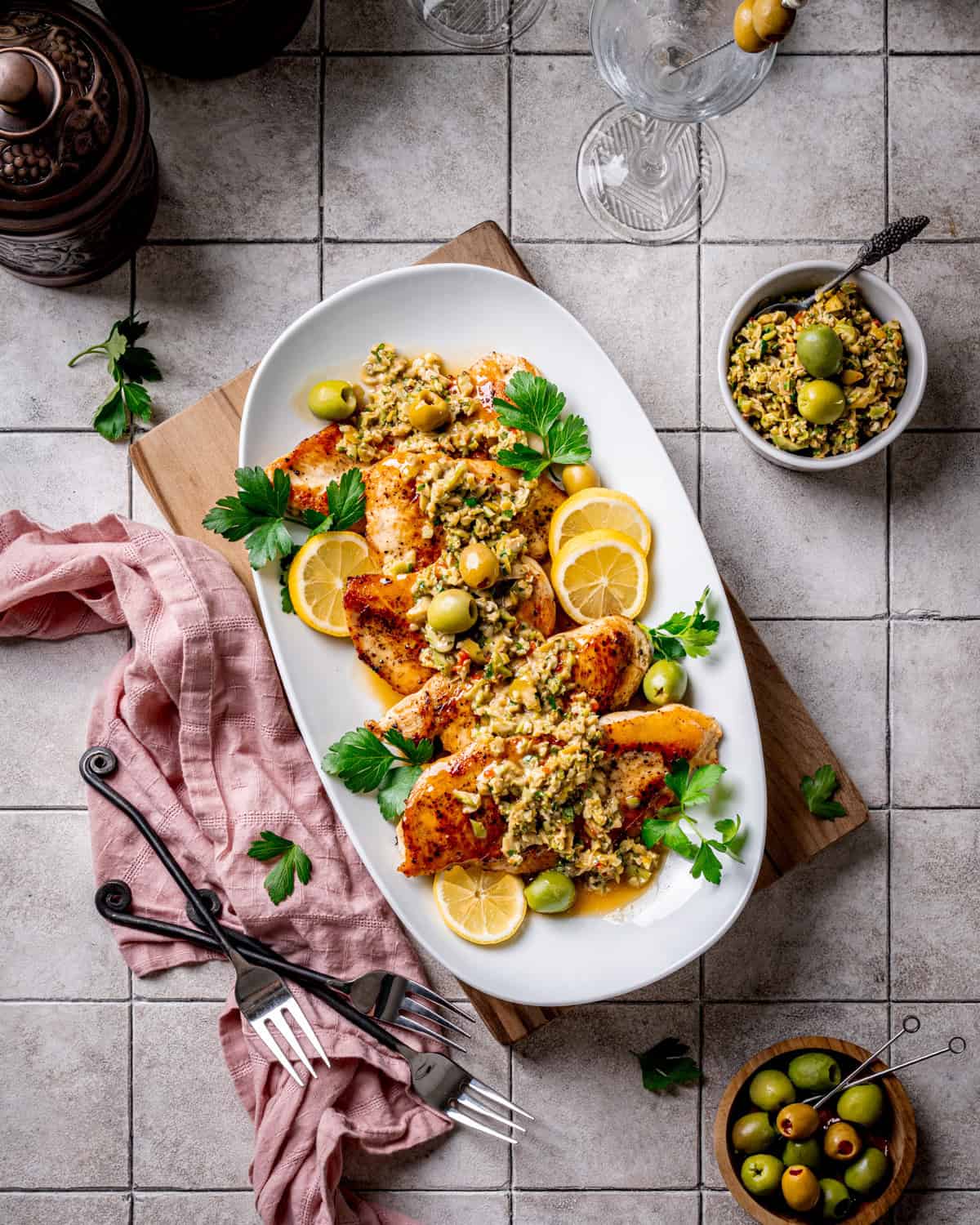
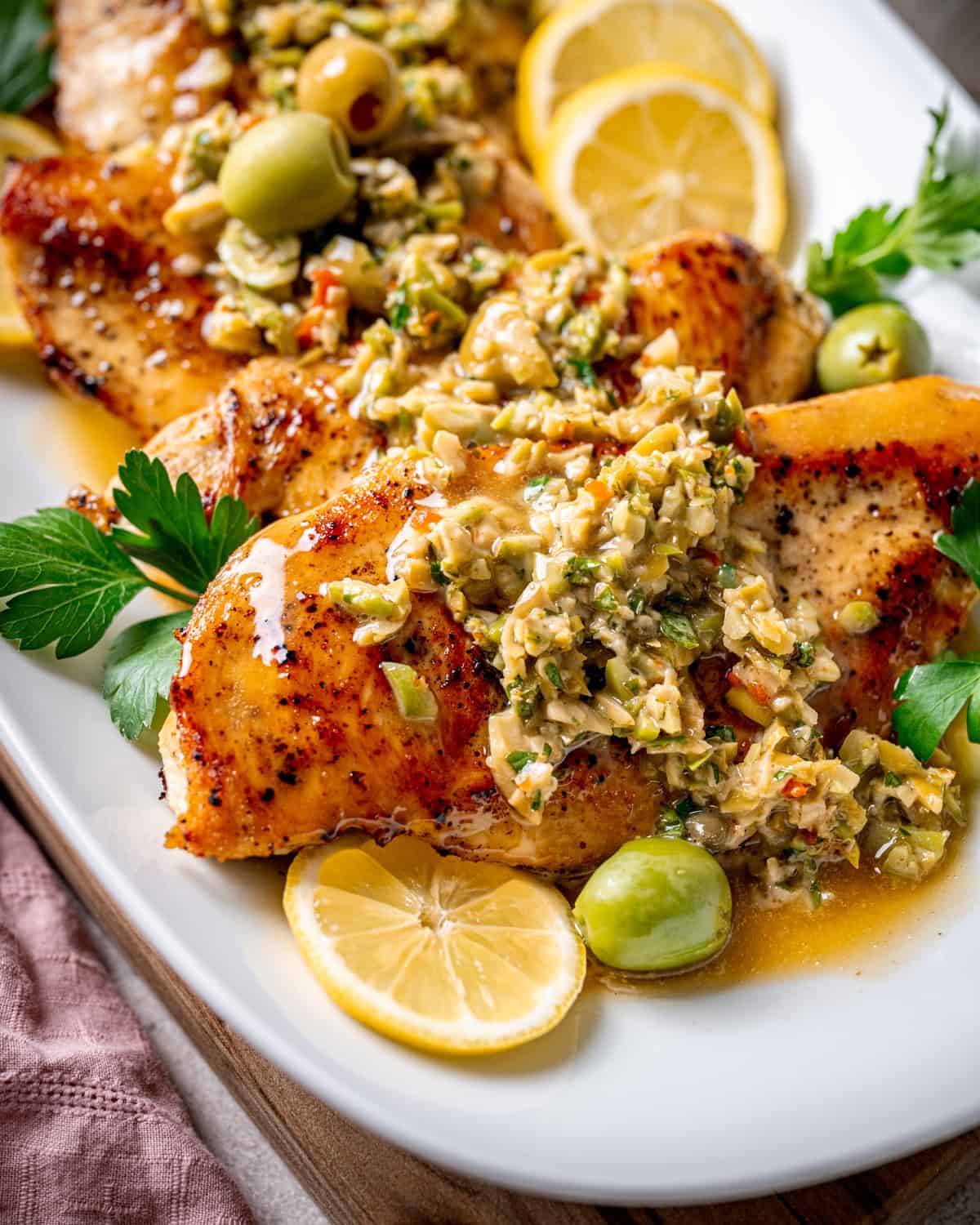
- Place the cooked chicken breasts on plates, spoon the sauce over each one then top with a generous scoop of tapenade. If you want (we always do) add some more sauce right over the top of the tapenade as well. Serve immediately.
The whole process from tapenade to plating takes about 50 minutes, but the active cooking is only 20, which makes this perfect for a weeknight.
How to Know When It's Done
Chicken and butter sauces both have specific visual and sensory cues that tell you when to stop.
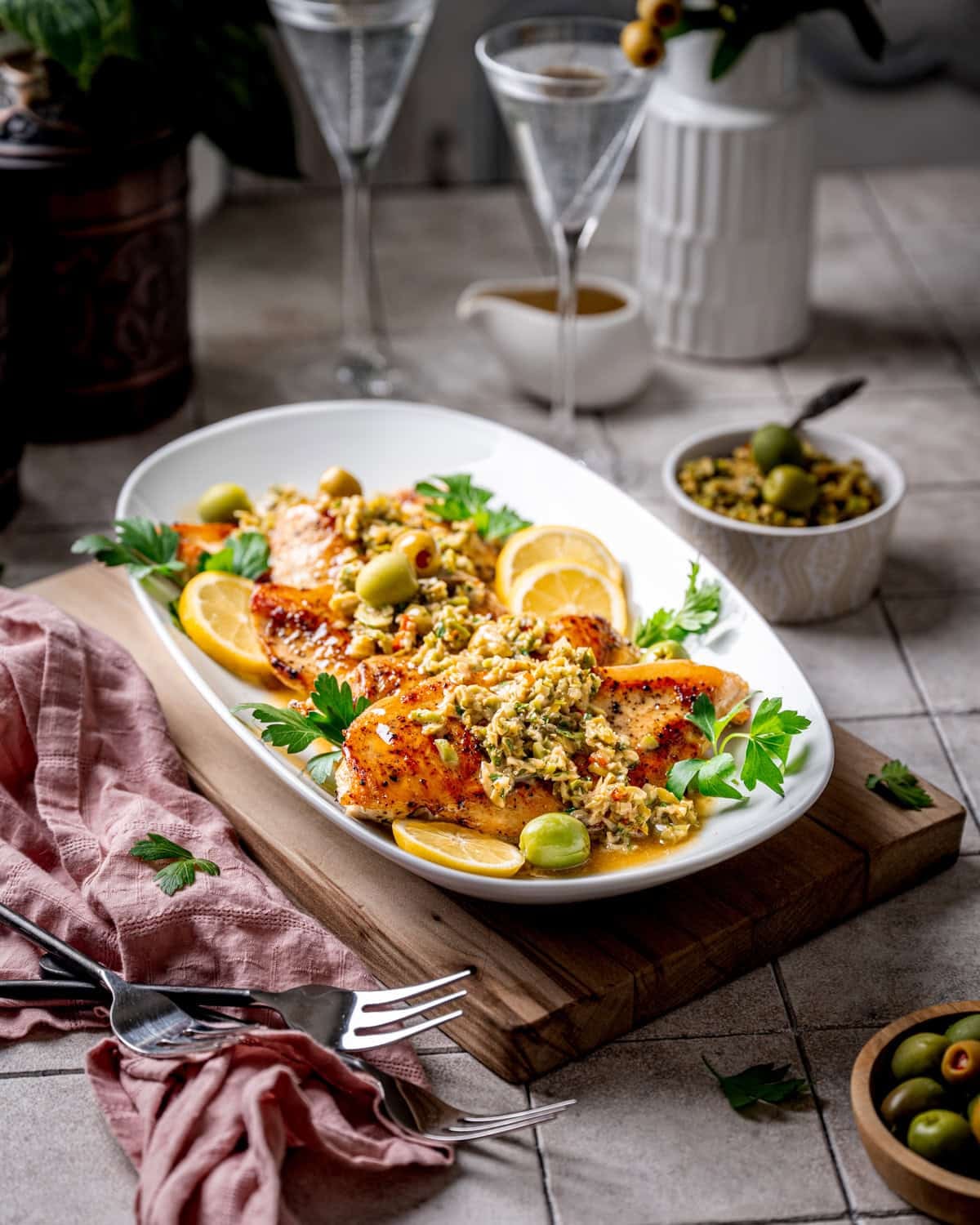
- For the chicken, you're looking for a deep golden crust on both sides, not pale and not burnt. When you press the thickest part of the breast with your finger, it should feel firm with a little give, like pressing the fleshy part of your palm below your thumb. If it feels squishy, it's undercooked. If it feels rock-hard, you've overcooked it. The internal temperature should hit 155-160°F if you want to check it with a thermometer, because carryover heat will bring it to 165°F while it rests.
- For the sauce, the reduction is done when you can see the bottom of the pan clearly as you drag a spatula through it, or if the liquid coats the back of the spoon without running off immediately. It should smell concentrated and boozy, not thin and watery. When you whisk in the butter, the sauce should turn from translucent to opaque and get noticeably thicker. If it looks greasy or separated, you added the butter while the liquid was too hot. You can sometimes save it by whisking in a teaspoon of cold water or a few ice chips off the heat.
- The tapenade is done when you can see distinct pieces of olive and herb, so trust your eyes and stop before it looks like a purée.
Variations
This recipe is flexible once you understand the core techniques, and you can shift the flavors in a few different directions depending on what you have or what sounds good.
- Swap the protein. Thin pork chops or turkey cutlets work just as well as chicken. Pound them to the same thickness and follow the same cook times. Fish like halibut or swordfish can handle the sauce too, but reduce the cook time to about 2 minutes per side.
- Change the tapenade base. Use Kalamata olives instead of green for a deeper, fruitier flavor. Add sun-dried tomatoes for sweetness or swap the basil for mint for a more Middle Eastern vibe. If you want it spicier, toss in a pinch of red pepper flakes or a small piece of fresh chili.
- Go richer. Add a splash of heavy cream to the finished sauce for a vermouth cream sauce. It's less martini, more decadent, but it works beautifully with roasted mushrooms or leeks on the side.
- Use thighs instead of breasts. Dark meat holds up to the bold flavors and stays juicier. Increase the cook time to about 6 minutes per side and make sure the internal temp hits 175°F.
Each variation still respects the core technique of building layers, reducing thoughtfully, and finishing with cold butter, so even when you do something different, the dish holds up.
Storage
Leftovers keep well if you store the components separately and reheat them with a little care.
How to store leftover Martini Chicken:
- The cooked chicken can go in an airtight container in the fridge for up to three days. The sauce will solidify as it cools because of the butter, which is normal. Store it separately in a small container. The tapenade keeps the longest, up to a week in the fridge in a jar with a thin layer of olive oil on top to prevent oxidation.
How to reheat leftover Martini Chicken:
- To reheat, slice the chicken and warm it gently in a skillet over low heat with a splash of chicken stock or water to keep it moist. Reheat the sauce separately in a small pan over low heat, whisking in a tiny pat of butter to bring back the glossy texture. Don't microwave the chicken or it'll turn rubbery. The tapenade can be served cold or at room temperature, so just pull it from the fridge 15 minutes before you eat.
Can you freeze leftover Martini Chicken?
- The chicken is the only component of this dish that can be frozen. If you freeze the chicken, do it without the sauce. Wrap it tightly in plastic wrap and then foil, and it'll keep for up to two months. Thaw it overnight in the fridge and reheat as directed. The sauce doesn't freeze well because the emulsion breaks when it thaws. The tapenade also won't freeze well as you'll lose flavor and texture.
Leftover Transformations
Leftover martini chicken is surprisingly good because the flavors are big enough to carry over into completely different meals. Here are some options to transform leftovers into fantastic meals over a few days:
- Slice the chicken thin and toss it with pasta, olive oil, and a handful of the tapenade for a quick cold pasta salad. Add cherry tomatoes, feta, and arugula and you've got lunch for two days.
- You can also chop the chicken and use it in a breakfast scramble or omelette adding whatever else you like!
- Make a sandwich by layering sliced chicken, tapenade, fresh mozzarella, and arugula on focaccia or ciabatta. Press it in a panini press or just toast it in a skillet. The tapenade acts as the condiment so you don't need mayo or mustard.
- For something lighter, shred the chicken and pile it on top of a grain bowl with farro, roasted vegetables, and a lemon vinaigrette. The vermouth sauce can be whisked into the vinaigrette for extra richness.
Top Tips from the Pros
- Let the chicken come to room temperature before cooking. Cold chicken hits a hot pan and the exterior overcooks before the center is done. Pull it from the fridge 15 minutes before you season it.
- Don't crowd the pan. If your skillet isn't big enough for all 4 pieces of chicken, cook them two at a time. Crowding drops the pan temperature and the chicken steams instead of searing. You lose the crust and the fond, which means your sauce will be weaker.
- Taste the sauce for salt. Vermouth varies in saltiness and your chicken stock might have been seasoned differently. A tiny pinch of salt can make the difference between a sauce that tastes flat and one that amazes.
Troubleshooting
This butter sauce is pretty basic, but it can break if you don't let the pan come down in temperature before adding the butter. If you add the butter too soon and it starts to break, add some ice chips or a small bit of very cold water and whisk vigorously. Then you can add some more cold butter.
What to serve with Martini Chicken
This chicken doesn't need much, but pairing it with the right sides makes the whole plate feel cohesive.
Serve it over creamy polenta, mashed potatoes, or buttered orzo. Something soft and neutral that soaks up the sauce and balances the briny tapenade.
Any green vegetable will work well with this dish. Especially green beans or broccoli. A simple green salad with a light vinaigrette is also a great accompaniment.
Serving Suggestions
For plating, center the chicken pieces on the plate, spoon the sauce over and around it so you get some on the plate, then pile a generous spoonful of tapenade right on top of the chicken. Garnish with a few extra basil leaves or a lemon wedge if you want it to look fancy.
What Drinks to Pair with Martini Chicken
Cocktails: If you want to go full cocktail mode, serve an actual martini alongside it, gin or vodka, very dry, with a lemon twist. The juniper in the drink will pair with the juniper in the dish and they will sing together!
Wine Pairings: A crisp, dry white wine pairs beautifully with this Martini Chicken. Try a French Chardonnay, Italian Pinot Grigio, or California Sauvignon Blanc.
For non-alcoholic options, go with a simple sparkling water with lemon. You could also go with tonic water for a gin and tonic vibe. Avoid anything sweet or heavy.
FAQ
It's just a playful name for this chicken dish. The flavors found in a gin martini and some botanicals used in making gin are highlighted here to make a nice chicken dish.
Dry, white vermouth is used. There are many brands to choose from but make sure it says dry and white.
Vermouth is simply a fortified wine with some herbal or spiced elements, depending on the producer. It usually runs between 16 and 19% alcohol when bottled.
Related
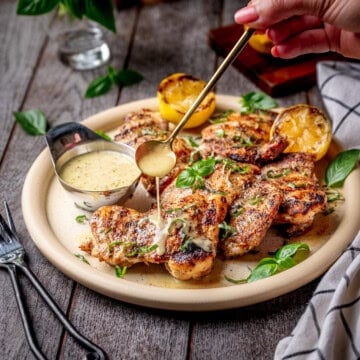
Looking for other chicken recipes like this? Try these:


Pairing
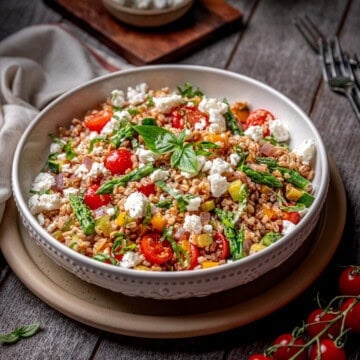
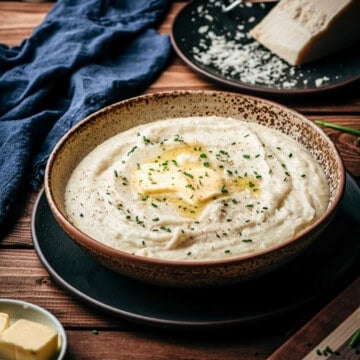
These are our favorite side dishes to serve with martini chicken:


📖 Recipe

Martini Chicken with Homemade Green Olive Tapenade
Equipment
- Meat mallet (optional but recommended): For pounding the chicken to even thickness. A heavy skillet will work here if you don't own a meat mallet.
- Spice grinder (optional but recommended) A mortar and pestle works well here too. If you don't have a spice grinder, you can buy pre-ground juniper, but the flavor won't be as bright.
- Food processor (optional but recommended) If you don't have a food processor, you can chop everything by hand and combine in a bowl.
- small saucepan for the sauce
- Fine mesh strainer for removing solids from the sauce base
- large skillet to cook the chicken
- whisk for the sauce
- meat thermometer (optional but recommended) to check the internal temp of the chicken
Ingredients
For the Tapenade
- 1 ½ cups green olives rinsed, pitted and halved or sliced
- 2 teaspoons capers rinsed
- ¼ cup parsley leaves
- ¼ cup extra virgin olive oil
- Zest of 1 lemon
- 3 Tablespoons lemon juice
- 1 large garlic clove minced
- 4 large basil leaves torn
For the Sauce
- ½ cup dry white vermouth
- ¼ cup chicken stock low-sodium or unsalted
- 10 juniper berries cracked gently with the side of a knife
- 10 black peppercorns whole
- 1 small shallot small dice
For the Chicken
- 4 Tablespoons unsalted butter cold
- 2 chicken breasts cut lengthwise into 4 pieces and pounded to uniform thickness (about ½" each)
- 10 juniper berries freshly ground
- 2 teaspoons Kosher salt
- 1 teaspoon black pepper
- 3 Tablespoons olive oil

Instructions
Make the Tapenade First
- Put the olives and capers in a strainer and rinse them under cold water for about 10 seconds. This washes off excess brine so the tapenade doesn't taste so salty. Transfer them into a food processor.1 ½ cups green olives, 2 teaspoons capers
- Add the parsley, olive oil, lemon zest, lemon juice, garlic, and torn basil to the food processor with the olives and capers. Pulse 5 to 10 times until you have a chunky, relish-like texture (alternatively, hand chop with a knife). You're not making a smooth paste. You want visible pieces of olive and flecks of herb. Scrape it into a bowl and set it aside. The tapenade can sit at room temperature for an hour or in the fridge for up to three days.¼ cup parsley leaves, ¼ cup extra virgin olive oil, Zest of 1 lemon, 3 Tablespoons lemon juice, 1 large garlic clove, 4 large basil leaves
Start the Sauce
- In a small saucepan, combine the vermouth, chicken stock, cracked juniper berries, peppercorns, and diced shallot. Bring it to a simmer over medium heat and let it reduce by half. This takes about 8 to 10 minutes.½ cup dry white vermouth, ¼ cup chicken stock, 10 juniper berries, 10 black peppercorns, 1 small shallot
- Once it's reduced, pour it through a fine mesh strainer into a measuring cup, pressing on the solids to extract all the flavor. Discard the solids.
- Pour the strained liquid back into the pan and continue reducing over medium-low heat. You're aiming for about ¼ cup of liquid. If it starts to reduce too much before the chicken is done, just turn off the heat. You can reheat it gently later.
Prep and Season the Chicken
- Cut your chicken breasts lengthwise to get 4 thin chicken cutlets. If your chicken breast cutlets are thicker than ½ inch, place them between two sheets of plastic wrap and pound them with a meat mallet or heavy skillet until they're uniform.2 chicken breasts
- Grind the juniper berries in a spice grinder until they're like pepper, then mix them with the salt and black pepper in a small bowl.10 juniper berries, 2 teaspoons Kosher salt, 1 teaspoon black pepper
- Pat the chicken breasts dry with paper towels. This step matters because wet chicken won't brown as well. Sprinkle the spice mixture all over both sides of the chicken, pressing it in gently so it sticks.
Cook the Chicken
- Heat a large skillet over medium heat. Once it's hot, add the olive oil and swirl it around to coat the bottom. Lay the chicken breasts in the pan gently, being careful not to splash hot oil. Press down on each breast with a spatula for about 10 seconds. This ensures full contact with the pan for better browning.3 Tablespoons olive oil
- Let the chicken cook undisturbed for 3 minutes. You'll see the edges start to turn opaque and golden. Flip the chicken and cook for another 3 minutes on the second side. The chicken should have a golden crust and feel firm when you press it. The chicken should be ready to remove at this point (check that the internal temp is around 155°-160°F).
- Remove the chicken to a plate, tent it loosely with foil, and let it rest while you finish the sauce.
Finish the Sauce, Plate and Serve
- Check your saucepan. You should have about ¼ cup of liquid left. If you have more, reduce it a bit more over medium heat. Once you're there, pull the pan off the heat and let it cool for one minute. This step is crucial because if the liquid is too hot, the butter will separate instead of emulsifying.
- Add one tablespoon of cold butter and whisk it in until it's fully melted and incorporated. Repeat with the remaining three tablespoons, one at a time. The sauce should turn glossy and thicken slightly. Taste it and add a pinch of salt if needed.4 Tablespoons unsalted butter
- Place the cooked chicken breasts on plates, spoon the sauce over each one then top with a generous scoop of tapenade. If you want (we always do) add some more sauce right over the top of the tapenade as well. Serve immediately.
Notes
- Chicken Breasts: Chicken tenders or chicken thighs, thin pork chops or turkey cutlets work just as well as chicken although cook time may vary depending on the type of protein used.
- Green Olives: Use different olives, such as Kalamata olives, to change the flavor of your tapenade.
- Lemon: Lime works here as well.
- Vermouth: A dry white wine can be used in place of vermouth for a slightly different flavor profile.
- Chicken Stock: Vegetable stock is a good option if you don't have chicken stock.
- Shallot: A small yellow onion will work in the sauce in place of shallots.
- How to store leftover Martini Chicken: The cooked chicken can go in an airtight container in the fridge for up to three days. The sauce will solidify as it cools because of the butter, which is normal. Store it separately in a small container. The tapenade keeps the longest, up to a week in the fridge in a jar with a thin layer of olive oil on top to prevent oxidation.
- How to reheat leftover Martini Chicken: To reheat, slice the chicken and warm it gently in a skillet over low heat with a splash of chicken stock or water to keep it moist. Reheat the sauce separately in a small pan over low heat, whisking in a tiny pat of butter to bring back the glossy texture. Don't microwave the chicken or it'll turn rubbery. The tapenade can be served cold or at room temperature, so just pull it from the fridge 15 minutes before you eat.
- Can you freeze leftover Martini Chicken? The chicken is the only component of this dish that can be frozen. If you freeze the chicken, do it without the sauce. Wrap it tightly in plastic wrap and then foil, and it'll keep for up to two months. Thaw it overnight in the fridge and reheat as directed. The sauce doesn't freeze well because the emulsion breaks when it thaws. The tapenade also won't freeze well as you'll lose flavor and texture.
- Let the chicken come to room temperature before cooking. Cold chicken hits a hot pan and the exterior overcooks before the center is done. Pull it from the fridge 15 minutes before you season it.
- Don't crowd the pan. If your skillet isn't big enough for all 4 pieces of chicken, cook them two at a time. Crowding drops the pan temperature and the chicken steams instead of searing. You lose the crust and the fond, which means your sauce will be weaker.
- Taste the sauce for salt. Vermouth varies in saltiness and your chicken stock might have been seasoned differently. A tiny pinch of salt can make the difference between a sauce that tastes flat and one that amazes.
Nutrition



Leave a Reply